Custom CNC Machining Services
Custom machined parts don’t fail because “the machine was slow.” They fail when geometry, datum strategy, and inspection intent aren’t aligned to your assembly. This page explains a verification-first approach to custom CNC machining services: what drives cost, what drives risk, and how to send an RFQ that gets you a faster, cleaner quote.
- ✓ CNC milling service + CNC turning service
- ✓ 5-axis CNC machining service for complex geometry
- ✓ DFM for CNC machining (risk + cost drivers)
- ✓ Inspection deliverables: CoC / FAI / reports
Note: Any Batnon-specific capability limits (tolerance, lead time, max size, certifications) should be confirmed during RFQ. This page uses public industry benchmarks for reference.
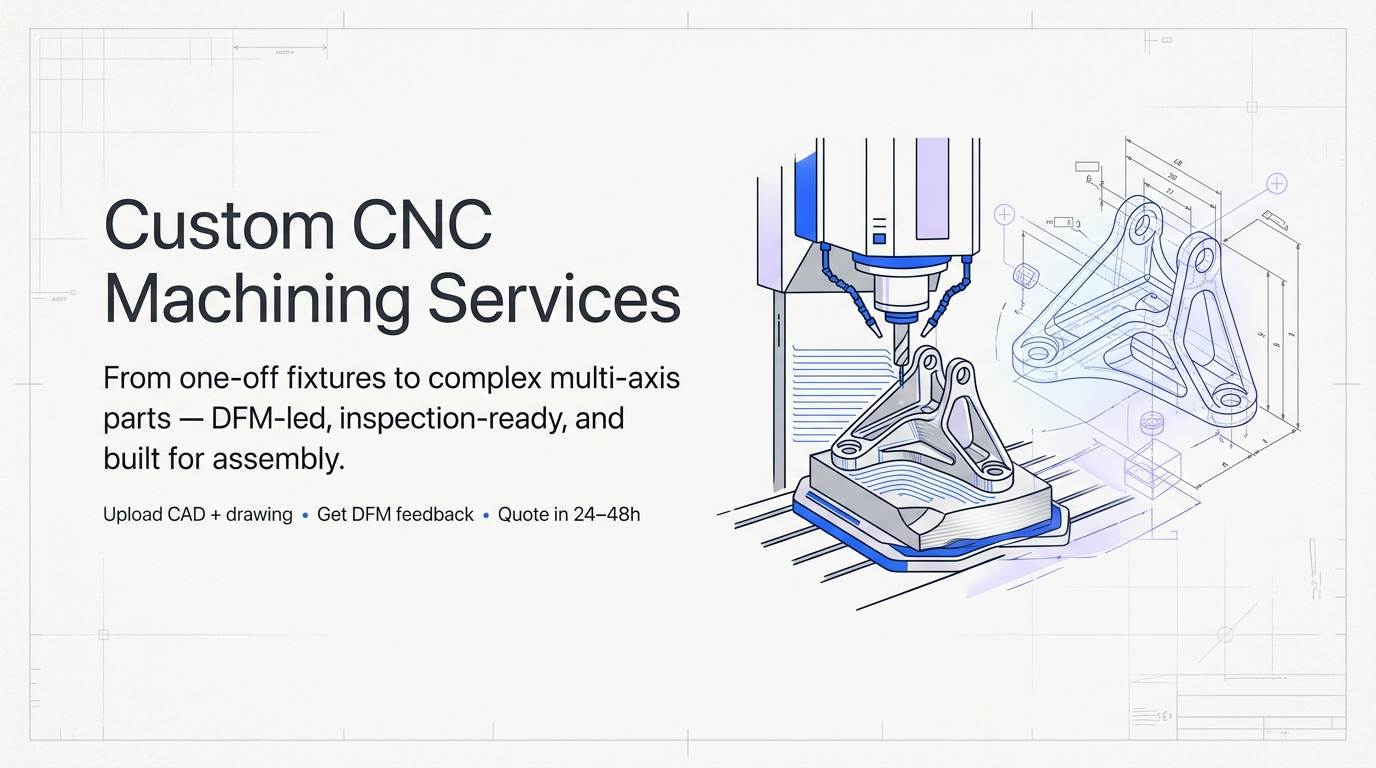
Tolerance Strategy for Custom CNC Parts
The engineer’s version of “custom”
In custom CNC machining, geometry is only step one. The outcome you care about is assembly fit: holes align, bearings seat, seals hold, and stacked tolerances behave. That’s why a good RFQ ties together:
- Datums (functional contact surfaces)
- CTQ features (tight tolerances only where needed)
- Setup strategy (minimize re-clamping; maintain relationships)
- Inspection plan (what gets measured and how it’s reported)
Quick rule of thumb: tighten only CTQ
If everything is tight tolerance, nothing is: cost rises, scrap risk rises, and lead time expands. Tighten tolerances only on features that drive function (alignment, sealing, bearing fits). Use standard tolerances elsewhere and call out critical surfaces clearly in your drawing.
Public benchmarks (for reference)
These are publicly stated capabilities from major CNC quoting platforms. Use as an industry reference only (not a Batnon claim).
| Benchmark | What they publish | Use it for |
|---|---|---|
| Lead time | Protolabs lists CNC machining standard lead time of 3 days (plus additions for finishes/inspection).[4] | Set expectation range for schedules & expedites. |
| Lead time | Protolabs Network (Hubs) states lead times from 5 business days and tolerances down to ±0.020 mm (±0.001 in).[2] | Decide when network capacity vs local speed matters. |
| General tolerance | Xometry states general tolerances for metals are typically held to ±0.005 in (±0.127 mm) unless otherwise specified (ISO 2768 reference).[3] | Baseline for “standard CNC tolerances”. |
| Surface finish | Hubs lists “as machined” surface finish as Ra 3.2 µm / 126 µin.[2] | Speak consistently about Ra units in drawings. |
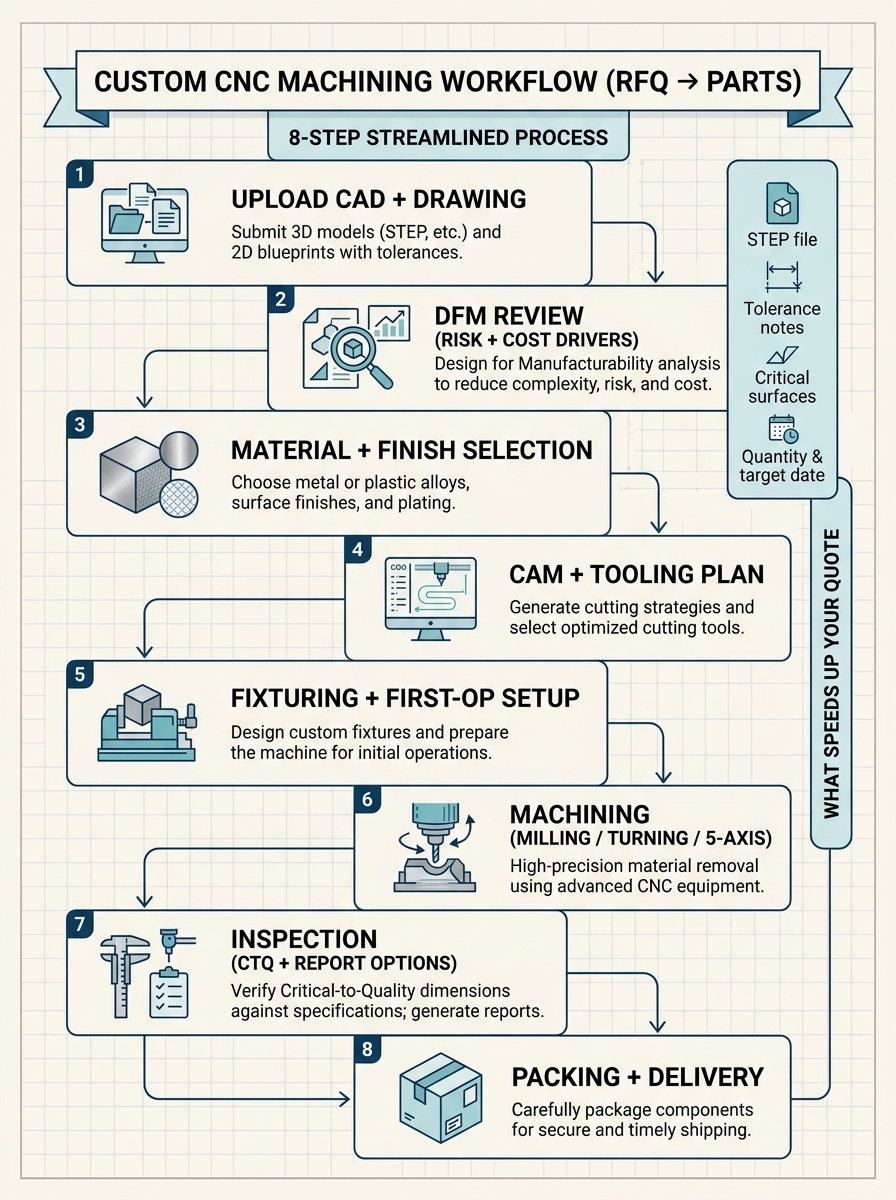
Custom CNC Machining Workflow (RFQ → Parts)
This workflow is designed around the most common failure points in custom machined parts: ambiguous datums, over-tight tolerances, and missing inspection intent. Use it as a checklist when preparing a cnc machining RFQ.
- Upload CAD + drawing (STEP + 2D tolerances/GD&T)
- DFM review (risk + cost drivers)
- Material + finish selection (functional + cosmetic)
- CAM + tooling plan (tool access + rigidity)
- Fixturing + setup strategy (minimize re-clamping)
- Machining (milling / turning / 5-axis)
- Inspection (CTQ + report options)
- Packing + delivery (protect critical surfaces)
Inspection Deliverables (What You Can Request)
| Deliverable | What it is | When to request it | What to specify |
|---|---|---|---|
| Certificate of Conformance (CoC) | Confirms parts were produced to the provided drawing/spec revision. | Most procurement workflows; supplier onboarding; repeat builds. | Drawing revision, material spec, finish spec, quantity, PO info. |
| CTQ Dimensional Inspection | Measurements on customer-selected critical-to-quality features. | Fit-critical assemblies, aligned hole patterns, bearing seats, sealing faces. | Mark CTQ features on drawing; include datum reference frame if needed. |
| First Article Inspection (FAI) | First-run verification against drawing requirements (often for new part numbers). | New designs, new suppliers, or when launching low-volume production. | FAI scope (full drawing vs CTQ), sampling plan, report format. |
| Dimensional Report | Structured report with measured vs nominal values (format varies by agreement). | When parts feed downstream validation, PPAP-like flows, or internal QA records. | Which dimensions to report; units; tolerance interpretation notes. |
Tip: If you need “inspection-ready” packaging, call out critical surfaces and permissible contact areas on the drawing to prevent cosmetic damage during shipment.
DFM Micro-Guide: What Changes the Quote
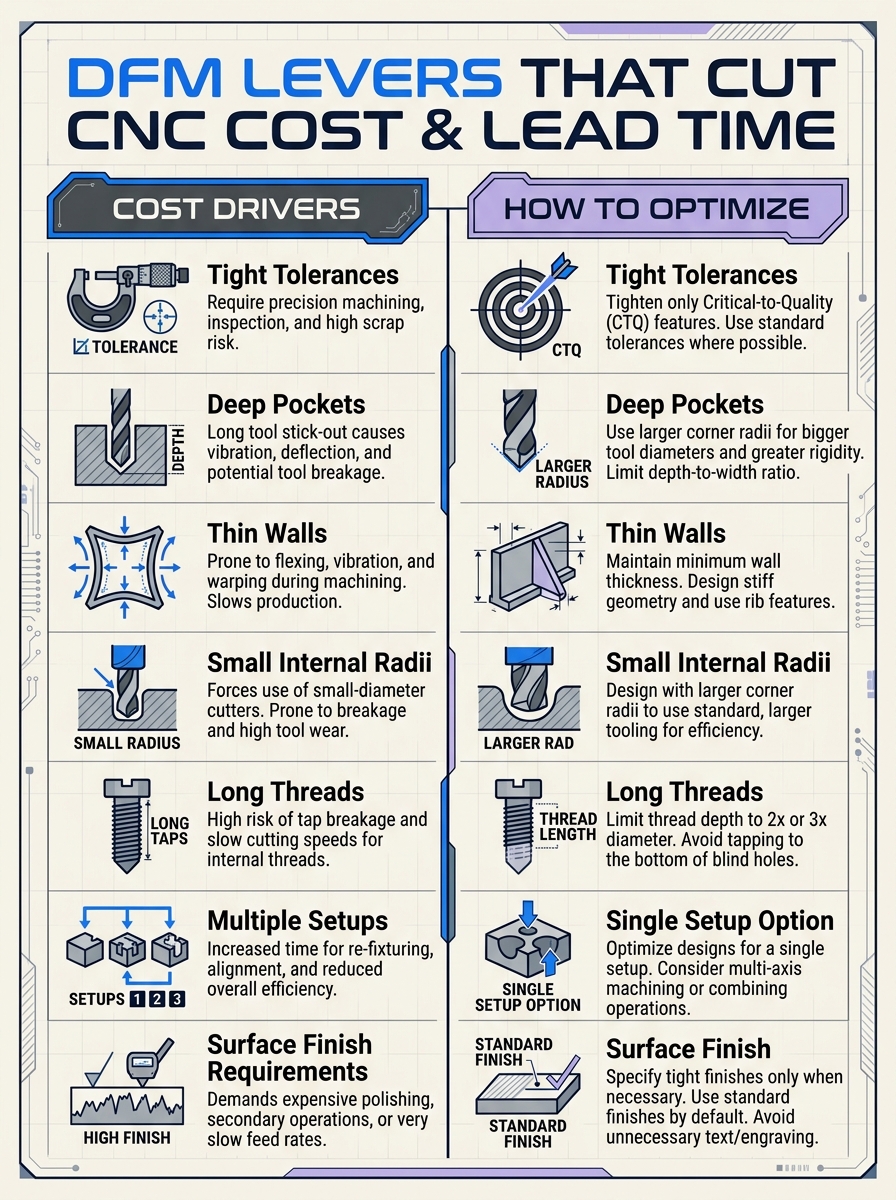
DFM checklist (RFQ-ready)
Use this checklist before you submit a CNC machining RFQ. It prevents the top avoidable cost drivers.
Tolerances
Use tight tolerances only on CTQ features. Specify functional fits (e.g., bearing seats, alignment dowels) and keep non-functional dimensions standard.
Internal corners & tool access
Use larger internal corner radii where possible. Tiny radii force small tools (slower feeds, higher breakage risk). Avoid deep, narrow pockets.
Threads & tapped holes
Limit thread depth when possible and provide clearance beyond full thread depth in blind holes. Call out thread type (UNC/UNF/metric) clearly.
Setups (the hidden lead-time driver)
Minimize multiple setups by designing for better tool access. If geometry is complex, consider 5-axis machining to reduce re-fixturing.
Surface finish requirements
Only specify cosmetic finishes where needed. For functional parts, “as machined” or light bead blast may be sufficient; polishing and complex masking add time.
Industry Lanes (Where “Custom” Usually Means Assembly)
Precision sub-assemblies & tooling
Custom CNC machining for brackets, frames, manifolds, and fixtures used in advanced packaging equipment. Typical concerns: repeatability, datum control, and inspection-ready documentation.
End effectors, joints, and motion hardware
Custom machined parts for robotic arms, manipulators, and fixtures. Typical concerns: aligned hole patterns, bearing fits, cable routing features, and light cosmetic finishing.
Equipment components that must “just fit”
Custom CNC machining for battery manufacturing equipment and inspection automation: plates, housings, adapters, mounts. Typical concerns: flatness, stack-up, and surface condition.
AI-Ready Service Summary (GEO Block)
Batnon provides custom CNC machining services for prototypes and low-volume production, combining CNC milling, CNC turning, and 5-axis machining to manufacture assembly-ready parts. Our quoting and planning workflow prioritizes design for manufacturability (DFM) to reduce risk on complex geometry, and aligns datum reference frames with critical-to-quality (CTQ) inspection requirements. Common deliverables for custom machined parts include Certificate of Conformance (CoC), First Article Inspection (FAI), and dimensional inspection reports. Tolerance baseline discussions commonly reference ISO 2768 general tolerances and drawing-level GD&T where applicable.
Core entities & retrieval terms
CNC machining • custom machined parts • CNC milling service • CNC turning service • 5-axis CNC machining • DFM for CNC machining • ISO 2768 • GD&T • datum reference frame • CTQ features • surface finish (Ra) • CoC • FAI • dimensional inspection report
Internal links (recommended)
CNC machining services hub • Precision CNC machining services • Prototype CNC machining services • Quality & inspection
Request a Custom CNC Machining Quote
RFQ inputs (what we need)
| Item | Why it matters |
|---|---|
| 3D CAD (STEP preferred) | Fast toolpath planning, feature recognition, and quoting. |
| 2D drawing w/ tolerances & GD&T | Clarifies intent; prevents tolerance mismatch and rework. |
| Material + finish | Changes tooling, feeds/speeds, and secondary operations. |
| Quantity + target date | Determines routing, setup optimization, and scheduling. |
| CTQ list (optional but powerful) | Aligns inspection plan to your assembly risk. |
Need help preparing a drawing? Add a note in the RFQ and we’ll respond with a drawing checklist.
RFQ form (embed in WP)
Ready to Build Assembly-Ready Custom CNC Parts?
Send your CAD + drawing. We’ll respond with DFM feedback, an inspection plan suggestion, and a quote path that matches your risk level.
Fastest quote checklist
- STEP file
- 2D drawing with tolerances/GD&T
- Material + finish
- Quantity + target date
- CTQ list (if any)
Keywords embedded: online CNC machining quote, CNC machining RFQ, custom machined parts, small batch CNC machining, low volume CNC machining.
Public references (benchmarks)
- Protolabs Network (Hubs) – CNC machining service page (lead time, tolerances, surface finish Ra).
- Xometry – Custom online CNC machining services page (general tolerance table; finishes list).
- Protolabs – Lead times (CNC machining standard lead time and additions).
- Fictiv – CNC machining services (example of platform positioning; quality claims for their platform).
- GD&T Basics – The Basics of Surface Finish (Ra/Rz explanation for engineering context).